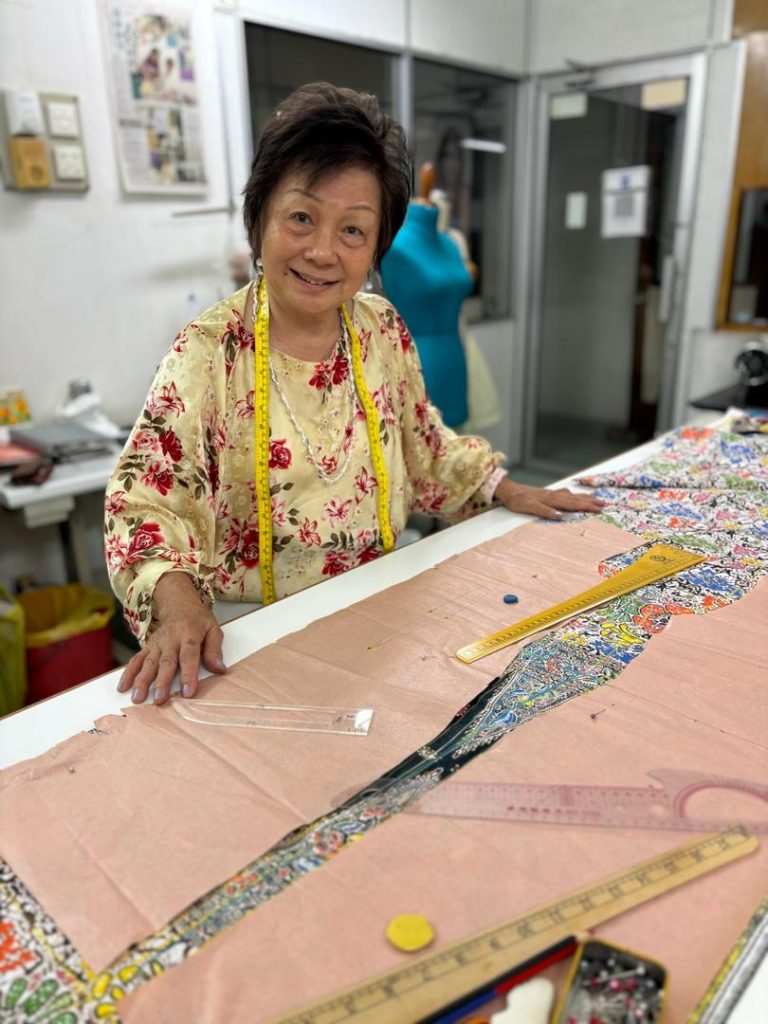
TAILOR Pang Ai Kim has long stopped taking orders for sewing clothes, but she has continued to teach dressmaking. The 75-year-old Pang’s tailoring classes have always been full even though few people get their clothes tailored these days. Pang understands perfectly the interest in learning to sew.
Growing up, she used to watch every step in fascination as her mother makes an apparel from beginning to end. It led to her taking an advanced tailoring course in Kuala Lumpur after secondary school. But Pang had set her sight further. She was determined to learn the craft from the best, and in the 1970s the best dressmakers were in Italy.
So, with only US$300 and head full of dreams, Pang took a leap and flew to Rome in 1972. She was 23, didn’t speak Italian and had nothing lined up.
“I was young and brave,” recalls Pang who remains interested in how to sew. Even though she has been sewing since her teens, she remains interested in how a garment comes together. As a teacher, she takes the trouble to explain the nitty gritty of tailoring; from how to snip at curved seams so they fall neatly to how to place patterns on fabric to achieve the most beautiful effects. Sewing formulae and the maths of sewing still seem fresh to her.
“I like to teach because it keeps me occupied and my brains active. I don’t want to retire and sit at home doing nothing,” says the 75-year-old Pang who teaches pattern making – with all its permutations and calculations – entirely from memory.
After all, Pang did go through a lot to pursue her studies in tailoring. As the eldest daughter in a working class family, her Italian dream wasn’t one her parents could finance.
But she has always been hard working and resilient, so Pang bravely forged ahead. After she landed in Rome, Pang managed to find a job as a nanny and saved up enough to enrol at the prestigious Ida Ferri Institute for three years, learning the art of Italian craftsmanship. Her Italian employer persuaded her to stay on as their live-in nanny, and she would send the children to school and then attend tailoring classes at the Roman institute, and then picked up her charges from school.
After she graduated, she worked for three years with a local couturier. By then, her boyfriend had joined her in Rome, and they got married and had a child there. Childcare was inaccessible and the family decided to come back to Malaysia in 1980.
Pang then set up the Italy Fashion and Dressmaking Institute in Sea Park, Petaling Jaya, where she tailored clothes and also held classes. But over the decades, the demand for tailored clothes waned as people opted for readymade clothes. Eventually Pang closed her tailoring business but she continued to teach dressmaking.
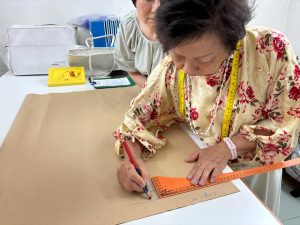
She conducts a basic dressmaking course, where students start off learning how to draft and make pattern blocks. So, for the first few lessons, students learn to draw patterns and make miniature patterns that they glue on their workbook. After that, students work on individual projects under Pang’s guidance. Students learn to make a skirt first, then a top and then combine both to make a dress.
There are no manuals or written notes. Students learn by observing and picking up the skills and techniques required – from taking measurements, making blocks, transferring the patterns on the fabric to finally sewing it all together. They also learnt to make piping, cords and frog buttons.
“It all depends on the student. Some already have some sewing skills and are able to pick up tailoring quickly. It also depends on their level of interest and how much they practise on their own,” says Pang who has held her own in this era of YouTube tutorials.
Learning from Pang is like apprenticing with an old master. She is exacting in her expectations and her sharp eyes catch sloppy work easily, be it a dart measured wrongly or seams that pucker. It’s not just enough to know to sew. Pang also encourages her students to be mindful of the fine details and finishing. With her years of experience, she has many tricks and tips to impart. Unpicking and repeating steps are pretty common, so don’t expect a hipster workshop when everything is done in one session.
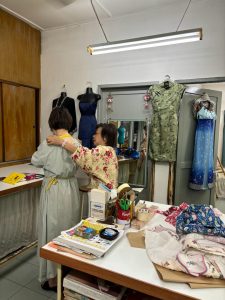
“It’s all about practice. Sewing is making things by hand, so you have to practise to learn. There are no shortcuts,” says Pang who is a patient and encouraging teacher, who tries to understand why people come and do lessons with her. Many students come for class to destress from a week’s workload and has no time to do homework.
Tax accountant Lim Chia Chian started learning sewing from Pang ten years ago. Although she does not come for class regularly anymore, she continues to look forward to sewing with Pang because “it’s a way of destressing.”
“When I am at sewing class, I just focus on sewing,” says Lim who is in the midst of making a batik cheongsam for the coming Chinese New Year.
Grandmother of 11, Tan See Fen, is also making cheongsam, but she is on a mission to sew cheongsam for her family.
She has sewing experience but has never learned professionally. Last year, her daughter suggested that she took lessons. After asking around, she found Pang and signed up for one-to-one classes.
“I told Pang I only wanted to learn to make cheongsam as I knew how to sew simple patterns,” recalls Tan who was a most enthusiastic student. The 69-year-old Tan would learn to make the pattern blocks and go home to sew, and then returned to class to troubleshoot.
“I look forward to learning. It keeps my mind active because I am always thinking of patterns and how to sew. It’s also so satisfying to see my daughters, daughter-in-law and grandchildren wearing the clothes I made,” shares Tan who is also inspired to sew when she buys beautiful good quality cotton fabric.
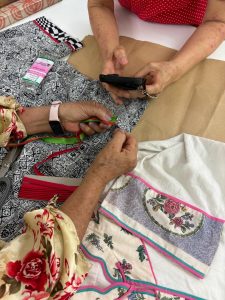
But mostly she credits Pang for guiding and teaching her to sew. Tan says she is sometimes in a hurry to finish making the clothes, but Pang would coax her to be mindful of the details. So, she often has to unpick and redo, but it’s the way to learn.
“Even if the work is not neat in the beginning, everyone can learn. And after making some mistakes and correcting them, the next time the work will be neat and beautiful,” assures Pang. After all these years, she still delights in a beautiful well-made apparel and is unabashed in praising her student’s work.
PANG Ai Kim had only US$300 on her when she flew to Rome, Italy in 1972.
She was 23, did not speak Italian and had no clear plans of what to do when she landed in the foreign city. But she had a big dream.
“I was young and brave,” recalls Pang, now 75.
All that mattered then was she wanted to study fashion and dressmaking in Italy, and she was excited to realise that ambition. Growing up, Pang used to sit by her mother’s side and watch her sew an apparel from start to finish. She remembers so clearly how interested and fascinated she was, and it led to her dreaming of enrolling in a fashion school in Italy, no less.
Pang started off by working as a nanny in an Italian household. After six months, she saved enough money to enroll in a fashion school but her employer persuaded her to continue working with them while attending classes when the children she babysat were in. Later, her boyfriend joined her in Rome and they married.
Pang and her family came back in 1979, and she set up the Italy Fashion and Dressmaking Institute in Sea Park, Petaling Jaya, in 1980, where she tailored clothes and also held classes. But over the decades, the demand for tailored clothes had waned as people opted for readymade clothes. Eventually Pang closed her tailoring business but she continued to teach dressmaking.
“I like to teach because it keeps me occupied and my brains active. I don’t want to retire and sit at home doing nothing,” says Pang who has count of how many students she had taught.
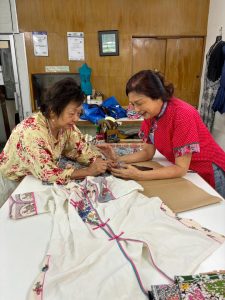
She conducts a basic dressmaking course, where students start off learning how to draft patterns. So, for the first few lessons, students learn to draw patterns and make miniature patterns that they glued on their workbook. After that, students work on individual projects under Pang’s guidance. Students learn to make a skirt, a top and then combine both to make a dress.
There are no manuals or written notes. Students learn by observing and picking up the skills and techniques required – from taking measurements, making blocks, transferring the patterns on the fabric to finally sewing it all together.
“It all depends on the student. Some already have some sewing skills and are able to pick up tailoring quickly. It also depends on their level of interest and how much they practise on their own,” says Pang who has held her own in this era of YouTube tutorials.
Learning from Pang is like apprenticing with an old master. She is exacting in her expectations and her sharp eyes catch errors easily, be it a dart measured wrongly or seams that puckered. It’s not just enough to sew, but Pang also expects her students to sew neatly and finely. With her years of experience, she has many tricks and tips to impart. Unpicking and repeating steps are pretty common, so don’t expect a hipster workshop when everything is done in one session.
“It’s all about practice. Sewing is making things by hand, so you have to practise to learn. There are no shortcuts,” says Pang who is a patient and encouraging teacher, who tries to understand why people come and do lessons with her.
Tax accountant Lim Chia Chian started learning sewing from Pang ten years ago. Although she does not come for class regularly anymore, she continues to look forward to sewing with Pang because “it’s a way of destressing.”
“When I am at sewing class, I just focus on sewing,” says Lim who is in the midst of making a batik cheongsam for the coming Chinese New Year.
“I had sewing basics but with Pang I learn to be meticulous. I was so inspired to sew, especially when I bought beautiful fabrics,” says Tan who was most impressed that Pang “taught her everything.”
Last Chinese New Year, she sewed cheongsam for her three daughters, daughter-in-law and five of her grandchildren who are girls.
“I felt so satisfied seeing my family in the cheongsam that I made for them.”

Post a Comment
 admin
Read More
admin
Read More
Catherine Lai, 62-year-old Entrepreneur And Socialite Mountaineering
Taking it one step at a time in pursuing her passion and inner peace, Enterpreneur…
 admin
admin 
Post a Comment
admin
Read More
Through The Lens of Famous Photographer Kenny Loh As The Years Go By
IF you look through Kenny Loh’s camera lens you will see a big heart. Well,…
admin 
Post a Comment
admin
Read More
The Will To Secure A Future – Carmen Phang
In the conventional narrative of life, we're expected to follow a linear path - study,…
admin